Introduction: Atrium glass inside malls and transit halls is cleaned under site constraints that outdoor facade work rarely faces, and those constraints decide what equipment fits.
A maintenance team looking up at twelve metres of atrium glass above a busy concourse already knows where the difficulty sits. There is no roof davit to hang a cradle from, no obvious tap for a hose, and rarely a good hour of the day to close the floor. The four conditions that decide the equipment choice are rigging access, floor loading, visitor hours and water supply, and each one points away from gear built for an exterior wall.
Indoor glass sounds easier than outdoor glass, and in one respect it is: the surface stays dry through rain and the wind never pushes equipment around. Everything else is harder. The glass sits inside an occupied building envelope, so the anchors, the water supply, the power and the floor all belong to the working part of the building rather than to a facade maintenance system. That reverses the usual planning order. Instead of asking how high a machine can climb, a facility team starts by asking where the machine can stand, how it reaches the glass, and what the surrounding floor is rated to carry.
A suspended cradle needs a fixed anchor at roof level — davit arms, a monorail, or certified tie-back points — plus a clear vertical drop line down the face. An atrium usually has none of these. The structure above the glass is the building's roof, frequently glazed or lightweight, and it was never designed to carry a swinging load. Scaffolding inside defeats the purpose: towers occupy concourse floor, block sightlines and take days to erect and strike. Floor loading sets the second limit. A loaded boom lift concentrates weight at its outriggers, and atrium edges often sit above retail units or service voids rather than a structural slab. A machine that holds itself against the glass and carries its own water and power sidesteps both problems, because nothing hangs from the roof and the load arrives at the glass instead of the floor beneath it.
In a shopping mall or a subway hall, the floor is the product: it is where people walk, queue and gather. A cleaning pass that ropes off a third of the concourse at two in the afternoon costs tenant goodwill, so atrium work slides into early mornings, late evenings or overnight shifts — exactly the hours when crews are hardest to staff. Equipment that shrinks the footprint of the job widens the number of usable hours, and that means one operator, a compact unit on the glass, and barriers confined to a narrow strip below the work area. Noise belongs in the same conversation, since a machine working while shops trade is heard by everyone on the floor. X-Human lists low-noise operation as a design feature of the Lingjing J1 SE, without a published decibel figure.
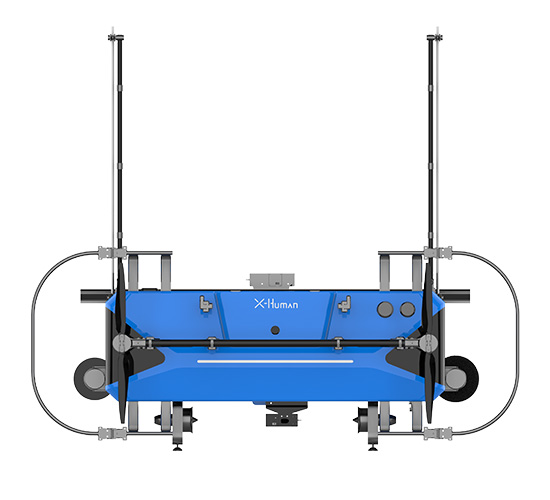
Water is the constraint that catches most atrium projects off guard. The nearest usable tap is often in a service corridor behind the retail units, a washroom on another level, or a loading dock at the rear of the building, and a hose crossing a live concourse is not something a facility team will sign off on. A tank carried with the machine turns water into a logistics question rather than a plumbing one: the run gets planned in legs, and the refill point is chosen for where a cart can wait without blocking an exit or sitting in front of a shopfront. X-Human specifies a 40L external tank on the Lingjing J1 SE for this kind of scene, together with a 48V 51AH battery and a nominal 8-hour runtime. A short planning exercise shows how those figures get used. A facilities coordinator marks the atrium glass into vertical bands, walks the route a cart would take from the service lift to the base of each band, and decides where the machine can be parked between passes. The battery sets how far the work can be spread across a day; the tank sets how often someone walks back to the refill point, which in turn sets how visible the operation is to shoppers. Both answers feed the schedule, and the schedule is what the venue actually cares about. The eight-hour figure is nominal, so teams usually plan a mid-shift top-up rather than one unbroken stretch, and the same logic explains why these machines are listed for malls, hotel lobbies, airport terminals, subway halls and atriums.
Outdoor facade washing is organised around height and weather. A machine must cope with wind loads and long vertical runs, and the safety discussion is about what happens if adhesion fails above a pavement. An atrium job inverts nearly every one of those priorities. The vertical run is short — a few storeys at most, often just the height of one shopping level — the wind is effectively zero, and the risk to manage is not a fall but a dropped tool, a splash on polished flooring or an inconvenience to a tenant. The soil differs as well. Indoor glass collects a thin film of dust, finger marks and, close to food courts, airborne grease, and it is generally cleaned on a cosmetic schedule rather than after a storm. Deployment changes too. Exterior equipment arrives on a truck, gets rigged at the roof and never enters the building. An atrium machine has to travel inside — through a service lift, along a goods corridor, past fire doors and into a space that may be in use while it works. That puts a premium on size, handling and how quickly a pass can be set up, rather than on vertical reach. The practical test of an atrium machine is not how tall it can climb but how fast two people can walk it into a hall, send it up a glass panel and clear the area before the first shoppers arrive. Teams that already run exterior cleaning often underestimate this difference, and it is the reason a second, smaller unit usually ends up on the atrium schedule.
Indoor atrium glass is not outdoor facade work brought inside. Missing roof rigging, floor loading limits at the atrium edge, the cost of closing visitor space and unreliable water access together push the decision toward a compact, self-contained machine that carries its own tank and battery and works one panel at a time. Equipment designed for an exterior wall optimises a different set of variables, which is why the shortlist rarely overlaps. When a facility team compares notes with a building cleaning robot manufacturer or a window cleaning machine supplier, four questions sort the options quickly: where does it anchor, what does it weigh on the floor, when can it work, and where does the water come from.
A: A cradle needs an anchor above the glass, and atriums rarely provide one. Davit arms, monorails and tie-back points belong to an exterior facade system; above an indoor atrium there is usually a roof or glazed structure that was never designed for a suspended load. Scaffolding and boom lifts fill the concourse instead, demand floor area the building may not have to spare, and take time to erect and remove. The surface itself is easy to reach — the access is what is missing.
A: It removes the two services an atrium cannot easily supply: a water point and a power outlet next to the glass. A robot running on a 48V 51AH battery with a 40L external tank carries its own water and power, works panel by panel from floor level, and needs a small operating footprint. That keeps the crew out of visitor routes, allows passes outside peak hours, and avoids hoses or cables trailing across a concourse. X-Human lists malls, hotel lobbies, airport terminals, subway halls and atriums among the Lingjing J1 SE use scenes.
A: No. Outdoor facade washing is planned around height and weather: roof rigging, wind limits and long vertical runs. Atrium work is planned around the building's occupants, with no roof anchor, floor loading restrictions at the atrium edge, tight visitor hours and water that has to be brought in. The two jobs therefore reward different equipment priorities, and an atrium machine is judged on footprint, tank and battery capacity, and how quickly it can be moved between halls.
Guide F: Energy efficiency in buildings (2012)
Working at Height: A Brief Guide