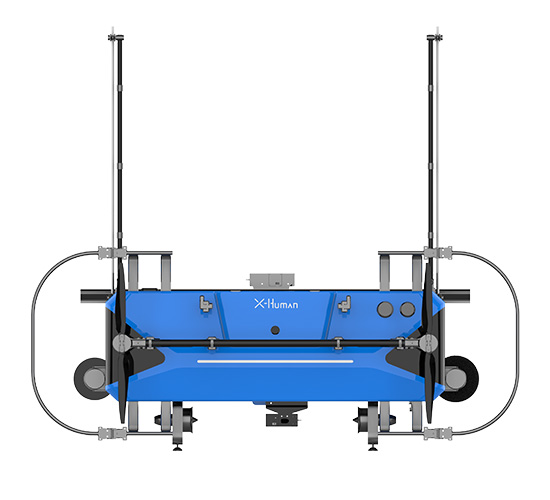
Introduction: Building height, facade material, joint gaps, slope, and weather exposure give a property team a practical first-pass answer.
Most office blocks and public buildings between two and fifteen storeys face the same problem: the facade needs cleaning, the budget is fixed, and rope access quotes keep rising while the available cleaning window shrinks. Before contacting suppliers, confirm whether the building sits inside the working range of a low-rise commercial machine. That range, together with the facade details below, determines whether a low-rise window cleaning robot is worth a serious look. HSE work-at-height law strengthens the case for replacing rope access on routine low-rise wash cycles, while the height and geometry measures determine whether a facade is a credible candidate.
Height is the fastest filter. The Lingjing J1 SE is built for 2–15 storey buildings and facades stated up to 30 m, including atriums and internal courtyards. A 40-storey tower with a continuous curtain wall needs a different class of machine and a different anchoring strategy. Measure the actual cleaning height rather than the nominal building height. Parapets, setbacks, and podium roofs can bring a facade well inside the 30 m figure even when the address sounds taller. Facade geometry is the second filter. The machine uses vacuum adhesion to stay against the wall and edge sensors to monitor its position, so it needs a flat, continuous surface. Deep reveals, protruding fins, sunshade louvers, balcony slabs, and window frames that stand out more than 5 mm break that continuity. Buildings with heavy articulation, irregular cladding, or large openable panels that stick out are complex facades and fall outside the standard range. Residential buildings fall outside the application as well; single-family homes and small apartment blocks need a different type of equipment.
Material and geometry decide how the machine runs day to day. The J1 SE is designed for glass, stone, aluminium alloy, and aluminium-plastic panel surfaces, which covers many office and public building facades. The cleaning setting changes by material: water volume, cleaning mode, and pass pattern. A facade that mixes glass with aluminium mullions and stone spandrels is normal and workable, provided each band is wide enough for the machine to travel without constantly crossing a different surface.
Glass is common on commercial buildings and generally the most straightforward surface. Dry mode lifts loose dust first; wet mode applies a fine water mist that loosens traffic film and pollution before the cleaning head lifts it away. Stone needs a gentler approach. Natural Stone Institute care guidance points to neutral cleaning and avoiding harsh chemistry on natural stone, and the same logic applies on a facade: light mist, moderate passes, and no chemical additive that could leave residue in pores. Aluminium alloy and aluminium-plastic panel are usually coated or painted, so the goal is to lift dirt without abrading the finish; light water volume and steady travel speed protect those surfaces. On the J1 SE, all four materials run through the same machine, with the 40 L external tank and 200 ml/min water draw making wet work practical where no water line reaches the facade.
Panel joints matter more than many property teams expect. The J1 SE crosses gaps up to 5 mm, which covers standard curtain wall and cladding joints. Where joint widths vary across a facade, the widest joint becomes the design constraint for the whole run, so measure a sample of joints in several areas rather than one. Slope is the other planning input: the machine works from 0° to 90°, so it can handle vertical walls and flatter surfaces within that range. That range lets one unit cover a vertical office facade and a flatter section, with the remote operator guiding horizontal and vertical passes around mullions, sealant lines, and edge details.
A useful first conversation with a supplier starts with the right numbers. Begin with measured height and storey count for each facade section you want cleaned, then add the panel module width and the joint width range you measured on site. Note every surface material and roughly what proportion of the elevation each one covers — glass, stone, aluminium, aluminium-plastic panel, or a mix. Add slope or curvature for any canopy, atrium roof, or angled section, and describe edge conditions: parapet height, roof access, ground staging area, and whether the machine can be lifted into position safely. Photographs of a typical bay plus one wide shot of the elevation help a supplier assess the site before a visit. Then add the operational data that determines whether the work can be scheduled. Confirm the ambient temperature range on site during your intended cleaning season against the machine's 10–60 °C operating window; winter mornings in colder climates can sit below that range. Record wind exposure. A building corner, a waterfront elevation, and a sheltered courtyard behave very differently, and the Beaufort scale is a simple way to describe typical and gust conditions to a supplier. Note water and power access points, working hours, noise limits if the building is occupied, and any tenant-facing restrictions. A building cleaning robot manufacturer can review that package and confirm whether the elevation fits and which configuration to discuss. It also gives you a fair basis for comparing quotes instead of brochures.
Most low-rise commercial buildings land clearly on one side of the line. If the elevation is two to fifteen storeys and within the stated 30 m maximum, with flat glass, stone, aluminium, or aluminium-plastic panel surfaces, joints up to 5 mm, and a slope within 0–90°, the building is worth discussing. If it is a tower, a house, or a facade full of deep fins and wide gaps, you can avoid an unnecessary procurement cycle. The practical next step is to send your height, material, joint width, slope, and working window to a window cleaning machine supplier and ask for a configuration suggestion and quote. X-Human can review that site data and recommend a suitable J1 SE setup.
A: Buildings above roughly 15 storeys or beyond the stated 30 m cleaning height fall outside the range, and so do skyscrapers, which need a different machine class. Residential houses and small apartment blocks need a different type of equipment. Complex facades with protruding fins, deep reveals, balcony slabs, or panel joints wider than 5 mm are also outside the standard range, because the machine needs a flat, continuous surface to hold and travel.
A: Glass, stone, and aluminum each work, but each needs its own setting. Glass takes dry dust removal followed by a wet mist pass to lift traffic film. Stone needs neutral water and moderate passes so residue does not sit in pores. Aluminum alloy and aluminum-plastic panel are usually coated, so light water volume and steady travel protect the finish. Mixed facades are common and workable as long as each material band is wide enough to clean without constant surface changes.
A: Collect measured cleaning height and storey count per elevation, panel module width, joint width range, and the materials present with their approximate coverage. Add slope or curvature for canopies and atrium roofs, plus edge conditions such as parapet height and staging access. Then add temperature range for your cleaning season, wind exposure, water and power access, working hours, and noise limits. Photos of a typical bay and the full elevation help the supplier assess the site before a visit.
Natural Stone Institute - Learn About Cleaning Products for Natural Stone